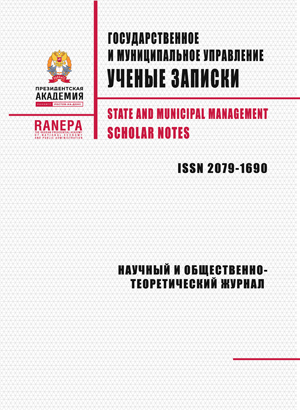
The scientific and practical peer-reviewed journal "State and municipal management. Scholar notes" publishes conceptual and empirical research by leading scholars from Russia and other countries. Its scope encompasses state and municipal administration, economics, political science, sociology, and management.
Current issue
PROBLEMS OF MANAGEMENT
Introduction. Not all organizations have a document labeled “development strategy,” but their structural divisions also have plans, projects, and programs that reflect a goal orientation for the foreseeable future. This situation is often explained by the fact that not all organizations can afford to expend resources on developing a strategy whose implementation will only yield results in the long term. However, the need for organizations to develop in a way that ensures success in competitive markets prompts stakeholders to rethink their target benchmarks and develop appropriate solutions.
The purpose is to demonstrate the feasibility of identifying promising development directions for an organization by adjusting its unstated, but actually implemented, development strategy, including through the use of artificial intelligence tools.
The methodological basis of the study is a content analysis of works in the field of strategic management, the functional approach and theory of strategic planning, methods for constructing a hierarchy of goals, as well as a systems approach and methods of graphical and verbal modeling in the process of making management decisions in combination with artificial intelligence tools.
The results of the study suggest a methodological approach to identifying an organization’s actual strategy based on an analysis of existing functional strategies. It is argued that the absence of a formally stated strategy does not imply the absence of strategic management – strategy is “manifested” through functional strategies and their objectives. An algorithm for transitioning from functional strategies to formulating an effective strategy is presented, including the stages of identifying functional objectives, constructing a goal tree, identifying contradictions, and synthesizing strategic priorities. A procedure for adjusting the identified strategy is developed based on an analysis of the organization’s potential and the challenges hindering the exploitation of external environmental opportunities, as well as a focus on benchmark strategies of leading organizations and the results of constructing a target block, including statements of vision, mission, and strategically significant objectives.
Conclusions. An organization’s current strategy typically contains inconsistent functional objectives, is inconsistent with the requirements of a changing external environment, and reflects insufficient consideration of the organization’s strategic potential. This requires adjustment, which can be achieved through an analysis of functional strategies. Functional strategies collectively form a “field of strategic behavior” for the organization, which can be adjusted by analyzing the objectives of these strategies and subsequently structuring them using artificial intelligence tools. A key methodological tool at all stages of organizational strategy adjustment is the goal tree, which provides a structured framework for hierarchical relationships between goals at various levels. The findings and recommendations can be used in developing organizational development strategies.
Introduction. The relevance of the study is due to two interrelated circumstances: on the one hand, the unconditional recognition of personnel safety as a significant structural component of the economic security of the enterprise, and, on the other hand, the variety of interpretations of the essential basis of this definition and, as a result, the lack of adequate methodological tools. This is confirmed by a summary made based on the results of a critical analysis of the profile literature, according to which each enterprise has the right to form its own personnel security system according to certain principles and criteria.
Purpose. Develop a methodology for diagnosing the level of personnel security of the enterprise, based on the identification of internal threats (problematic issues in the personnel labor motivation system); conduct its pilot testing at the enterprise of the basic experiment in order to check the adequacy of its purpose.
Theoretical foundations and methodological tools. The theoretical foundations of the study are associated with: the identification of the personnel security of the enterprise with the normal level of labor motives of the personnel, ensured by the elimination of internal personnel threats; correlating the types of personnel threats with the disadvantage of specialized labor motives; using the ratio between actual and critical (minimum permissible) values of personnel indicators to identify personnel threats; with the allocation of four levels of personnel security of the enterprise (depending on the number of identified personnel threats).
Results. The substantive aspects of the definition of “personnel safety of the enterprise” were clarified; the theoretical foundations of diagnosing the level of personnel security of the enterprise are substantiated; a methodology has been developed for diagnosing the level of personnel security of an enterprise, based on identifying problems in the labor motivation system; based on the results of pilot testing of the procedure, its adequacy to its purpose was confirmed and targeted recommendations were justified.
Conclusions. Each company should regularly monitor the level of personnel security in order to timely identify and eliminate possible personnel threats.
Introduction. The digital transformation of the urban environment is one of the most significant processes shaping the contours of modern urban planning policy. The article examines how digitalization transforms the mechanisms of state urban planning management and what economic consequences this entails for the development of cities and regions. The authors argue that digitalization not only complements existing administrative procedures with new tools but fundamentally changes the logic of urban planning management: from reactive regulation to predictive modeling, from closed departmental processes to platform solutions involving multiple stakeholders, from fragmented functions to the integration of urban planning data into unified city digital platforms.
Purpose. To develop a conceptual model of the digital transformation of urban planning management mechanisms, to identify regional economic effects of implementing digital solutions, and to substantiate the role of public environmental control in ensuring the balance of urban planning policy.
Materials and methods. The methodological framework includes systemic, institutional and evolutionary approaches, as well as methods of data analysis, content analysis, comparative analysis, case study, typological analysis, correlation and regression analysis. The empirical base includes data from the Ministry of Construction of the Russian Federation, digital maturity and digitalization ratings of regions, Rosstat materials, and international cases.
Results. Five key areas of transformation are identified: introduction of digital twins of cities, development of state information systems for urban planning activities, automation of permitting procedures, creation of urban planning platforms, use of AI and big data. Economic effects are systematized: reduction of the investment and construction cycle (20-30 %), reduction of administrative costs (2-3 times), increase in investment attractiveness of territories. A typology of regions by the level of digitalization of urban planning management is developed. We propose a conceptual model for transitioning to a digital platform-based governance framework, distinguished by the integration of environmental control and public participation.
Conclusions. Digitalization of urban planning management is a paradigm shift in spatial development management. Economic effects do not arise automatically,but depend on the quality of management and organizational changes. Leading regions of digital transformation demonstrate the best indicators of the quality of the urban environment and the volume of housing construction.
PROBLEMS OF ECONOMICS
Introduction. As competition for human capital intensifies, the quality of the urban environment becomes a key factor determining the attractiveness of territories for living and doing business. A comfortable urban environment creates favorable conditions for the development of small and medium-sized enterprises (SMEs). The relevance of the study is due to the need to identify quantitative parameters and mechanisms of this relationship.
Purpose. To investigate the relationship between the quality of the urban environment and the development of small business in the regions of the Russian Federation, to determine the character and strength of the influence of the environment on the efficiency of SMEs.
Materials and methods. The methodological framework includes correlation, cluster, comparative and content analysis. Data from the Urban Environment Quality Index of the Ministry of Construction of the Russian Federation for 2024, statistical compilations of Rosstat, ratings of RIA Rating, VEB.RF, as well as data from specialized Internet resources were used.
Results. A stable positive relationship between the quality of the urban environment and SME indicators was revealed. The strongest correlation is with the turnover of small enterprises per capita (R=0.74). Using clustering, four types of regions were identified, including the phenomenon of “compensatory” SMEs (high employment with low efficiency). A detailed analysis of the Southern Federal District confirmed the presence of leading regions, regions with unrealized potential, and “compensatory” territories.
Conclusions. The quality of the urban environment significantly affects the efficiency of SMEs, and not just the scale of employment. A differentiated approach to supporting regions is needed depending on the identified type. Investments in improvement and “framework” infrastructure should be synchronized with business development programs to achieve a synergistic effect.
Introduction. The shortcomings of the domestic system for assessing environmental protection measures and eco-investments are related to the assessment methodology itself, including: the lack of unified methods for calculating prevented damage, the incomparability of costs between regions, the fragmented nature of statistical accounting by periods and included components, and the lack of consideration of delayed effects from capital investments. This leads to incorrect interregional comparisons, a systemic imbalance in compensation mechanisms, and a systematic underestimation of the actual effectiveness of capital-intensive eco-projects.
Purpose. Based on a comparative analysis of methodologies for assessing the effectiveness of environmental protection measures in the Russian Federation and abroad, identify institutional and statistical limitations, assess the actual environmental and economic effectiveness using the example of several regions of the Russian Federation, and develop an integrated model that balances fiscal, restorative, and incentive functions.
Methods. The study was based on a systematic and institutional approach, conceptual modeling, a comparative analysis of foreign and domestic methods, and an economic and statistical analysis of empirical data from various regions of the Russian Federation. The selection of regions for analysis was carried out based on the principle of theoretically grounded typological sampling, using formalized criteria (the share of industry in GRP, the volume of emissions, and the availability and completeness of statistical series).
Results. The study identified a systemic imbalance in compensation mechanisms in the Russian Federation, the lack of a unified methodology for assessing the effectiveness of environmental protection measures, and a low share of private environmental investments. Using a modified DEA model, a ranking of regional efficiency was constructed, and a direct correlation between eco-investments and damage reduction, as well as the delayed effect of capital expenditures in projects, was established. An integrated model was developed, which includes a methodology for assessing real damage taking into account ecosystem services, the calculation of economically justified compensation rates, and tools for assessing the contribution of environmental protection measures to achieving sustainable development goals.
Conclusions. The implementation of these solutions will help overcome key methodological and institutional barriers, transforming the assessment of the effectiveness of environmental protection measures into a proactive tool for managing natural capital, which ensures the synergy of the three priorities for sustainable regional development.
Introduction. The contemporary public sector operates under conditions of increasing complexity in managerial functions, digitalization of the budgeting process, expanded interagency coordination, and heightened demands for efficiency in the use of public funds. Under these circumstances, research focus has shifted from mere compliance with budgetary discipline to the evaluation of internal processes, as losses of public resources occur not only during budget execution but also in off-budget processes. Excessive documentation and approvals, redundant manual data entry, paper-based records, repeated returns of documents for revision, and increased labor inputs may not individually constitute budgetary risks, but they hinder the effective delivery of public functions within a changing institutional environment.
Purpose. This study aims to substantiate the development of internal financial audit into a comprehensive internal audit system within public sector organizations and to identify institutional conditions under which such a transformation can be regarded as a factor enhancing operational efficiency in these organizations.
Methods. The research employed theoretical, institutional, and comparative-legal analyses, alongside examination of normative, methodological, scientific, and official analytical materials. This approach enabled investigation of the issue at the intersection of auditing practices, budget regulation, internal control, accounting, public auditing, and risk management.
Results and Conclusions. The current Russian model of internal financial audit represents a mature budgetary-legal framework; however, its scope is confined to budgetary procedures, budgetary risks, internal financial control, budget accounting, budget reporting, and financial management quality. Operational efficiency emerges across a broader set of internal processes, including drafting of regulatory acts, strategic planning, execution of directives, permitting and supervisory activities, handling of citizen and organizational requests, and supporting functions such as human resource management. Consequently, the influence of internal financial audit on operational efficiency is indirect and partial. A four-stage transformation model is proposed, consisting of a federal pilot, extension to subordinate agencies, expansion to regional and municipal levels, and subsequent coverage of budgetary and autonomous institutions, with concurrent implementation of legal, methodological, organizational, and human resource measures to prevent superficial expansion of the audit scope without enhancing analytical rigor.
Introduction. The article examines the current issues of the transformation of the control activity institute under the influence of digitalization processes in the economy. The digital economy imposes new requirements on the speed, accuracy, and proactivity of control mechanisms, which contradicts established, bureaucratic models of state and internal control.
The purpose of the study is to develop theoretical and methodological foundations and practical directions for the development of the control activity institution adequate to the challenges of the digital age.
The methodological framework comprises institutional economic theory, a systems approach, and methods of conceptual modeling.
Results and conclusions. Based on the analysis of advanced foreign and Russian practices (including COSO approaches, the concepts of “Control 4.0”, and predictive analytics), a key contradiction has been identified between the need to transition from retrospective to proactive, risk-based control and the persisting paradigm of punitive supervision. The article proposes a set of breakthrough ideas grouped into four areas: a paradigm shift (from controlling the past to managing the future), technological breakthrough (digital twins, blockchain, artificial intelligence), institutional changes (regulatory “sandboxes”, “smart regulation”), and cultural transformation (a new system of motivation for controllers, compliance culture). The necessity of creating a unified cross-sectoral platform “Compliance of Russia” as a key element of the digital trust ecosystem is substantiated. Criteria and indicators for assessing the effectiveness of control activities in the context of digital transformation have been developed. The scientific novelty lies in the integration of institutional and technological approaches to form a holistic model of the “digital control institution,” which takes into account both formal rules and informal practices.
POLITOLOGY AND ETHNOPOLITICS
Introduction. The problematization of the essence and functionality of civil society is a traditional, modern, and promising research niche within political science. Political analysis shows that global civic self-organization is highly correlated with political space and political time, forming unique institutions of social activity. The functioning of civil society in modern Russia generally follows generally recognized theoretical, methodological, and functional-organizational algorithms. At the same time, a number of specifically Russian politically significant essential determinants and functional practices of civil self-determination and self-government in the Russian Federation are identified, which are актуализируются in geopolitical conditions. Domestic and foreign policy demands are clearly evident; they motivate a new content for the positioning of public associations, as well as a new state-patriotic loyalty as the programmatic basis for the functions of public associations with ethno-confessional determinants. A certain evolution is demonstrated by politically significant activism of national-cultural and religious organizations in the North Caucasus Federal District (NCFD).
Purpose. The analysis and identification of the resources and practical manifestations of the politically determined, state-patriotic loyalty of public organizations with an ethno-confessional focus – the subjects of the national model of Russian civil society – as patronage-partnership and rational-positive.
Theoretical Basis. The research is based on an institutional approach within the framework of the methodology of political science to identify the essential-structural and functional-role determinants of Russian civil society. Neo-institutionalism and the concept of “political opportunities” are used to specify the political vector of public associations. In highlighting the political trajectory of civic selforganization, a political-axiological, value-based approach is applied, which is actualized in parallel with the actualization of values in politics. The structure of modern civil society was supported by the concepts of the networkization of public policy and the political dimension of civic (in this case, ethno-confessional) self-organization. Theoretical research-identitarian generalizations were used to interpret the ethno-confessional foundations of self-organization in the socio-political process.
Results. The process of civic association has many objective determinants and subjective projections, which are dependent not only on political systems and political regimes, taking into account domestic and foreign policy factors, but also on the historical-cultural and even mythological narrative in each specific state-country expression. The subjects of civil society, institutionalized on the basis of ethno-confessional identity, strengthen their positioning in the socio-political process, acquiring indirect properties of political subjectivity. Its conditionality and motivation in relation to national-cultural and religious organizations, in a broad sense, are expressed in socio-political activism and in politically determined state-patriotic loyalty. National-cultural and religious public organizations of the North Caucasus Federal District: a) use ethnocultural and ethno-confessional potential to protect traditional North Caucasian values and strengthen Russian civic identity; b) expand practical experience in shaping patriotic thinking among today’s Russian youth as a counterbalance to radical, extremist, and social deviations; c) protect the sovereignty of the Russian cultural code.
Conclusions. In the formation of a sovereign Russian civil society, the humanistic and spiritual-moral component of the self-organization of Russian citizens is emphasized, based on the Russian civilizational paradigm as a multi-ethnic and multi-confessional one. The foundations of the state-patriotic loyalty of national-cultural and religious organizations as subjects of civil society are rooted in the historical-cultural and socio-political tradition of the relationship between the state and citizens. The politically determined components and politically projected experiences of national-cultural and religious organizations are shaped by the trends in Russia’s nation-state building, as well as by the needs of the modern Russian socio-political space in the context of international risks and geopolitical dysfunctions. In the interaction between the state and civil society, the range of public initiatives with a state-patriotic focus is expanding; these initiatives are implemented within the framework of state-religious relations and the state national policy of the Russian Federation.
Introduction. The article analyzes destructive processes that threaten the national security of the Russian Federation and domestic political stability in the context of the expansion of non-regional players in the South Caucasus. The urgency of the problem is determined by the threats and risks that have arisen that can affect the stability of interethnic relations and the unity of the peoples of Russia.
Purpose. Identification and analysis of factors and trends that pose threats and risks to national security and stability, and interethnic harmony in the Russian Federation.
Materials and methods. In the study, the authors used documents from government authorities of the Russian Federation and the South Caucasus states; official statements from heads of state; and scientific research related to the regional issues under consideration. The materials of the regional media are considered as sources allowing to reconstruct the course of historical processes in the South Caucasus in the post-bipolar period. The article uses a historical and comparative research method, as well as analysis, synthesis, generalization and comparison.
Results and conclusions. The role and influence of non-regional players on the South Caucasian states is regarded as a consistent and long-term anti-Russian strategy to implement the foreign policy vector of the NATO countries, aimed at forming disintegration processes with Russia, provoking ethnic strife and interfaith intolerance. Regional stability, transformed under the influence of a new stage of escalation of military-political conflicts in the South Caucasus, which occurred in the first quarter of the XXI century. – The five-day war in South Ossetia in 2008 and the defrosting of the Nagorno-Karabakh conflict in 2016-2023 have become a serious challenge to Russia's national interests. Territorial disputes and ethnopolitical conflicts between the post-Soviet republics of the South Caucasus, which are projected into the Russian North Caucasus through numerous South Caucasian diasporas and migration flows, remain a key factor in destabilization. The foreign policy of the elites of the South Caucasus states, which have revised relations with Moscow, translates relevant ideological attitudes and narratives to diasporas, and influences the interethnic and interfaith unity of the peoples of the Russian Federation. The authors conclude that these issues are relevant and that it is important to study such trends and processes in order to preserve regional stability and strengthen civil and national unity in the Russian Federation. The combination of these risks and threats is considered as a serious challenge to the territorial integrity and interethnic unity of the peoples of Russia. Timely response – Russian President Vladimir Putin declared 2026 the Year of Unity of the Peoples of Russia, and the state national policy of the Russian Federation has been updated.
Introduction. The strategic imperative of the Republic of Adygea’s development policy is to leverage intangible resources such as cultural and historical heritage, human capital, institutional capital, and reputational capital. Adygea has unique development conditions, including close economic integration with the Krasnodar Krai, a unique historical and cultural heritage, and an agriculturally focused economy. Over the past five years, the republic has demonstrated mixed performance in its socioeconomic indicators. While certain indicators (tourism and investment) have shown growth, structural problems (population outflow, low share of the innovative economy) persist. An analysis of official documents and statistical data allows us to assess the effectiveness of the current development policy and identify opportunities for improving the effectiveness of intangible resources.
Purpose. To study the potential of the Republic of Adygea’s intangible resources and develop evidence-based recommendations for their integration into regional development policy.
Methods. The study utilized systems analysis, a comparative method, a statistical analysis of socioeconomic indicators, and a SWOT analysis of the region’s intangible resource potential.
Results. It was found that the Republic of Adygea’s intangible resources (cultural and historical heritage, human capital, institutional capital, and reputational capital) are underutilized. Problems and barriers to the use of intangible resources were identified. A classification of the region’s intangible resources was developed, and strategic directions for their integration into development policy were proposed.
Practical Relevance. The study’s results can be used by government bodies of the Republic of Adygea when adjusting the Socioeconomic Development Strategy until 2036, as well as in developing regional programs to support creative industries and ethnotourism.
Conclusions. For the first time in the Republic of Adygea, a comprehensive assessment of the potential of intangible resources from a regional governance perspective was conducted. The need to include intangible asset indicators in the region’s strategic planning system is substantiated. The key to a targeted development policy for Adygea is interdepartmental coordination, partnership between government, business, and civil society, as well as systematic work to preserve and enhance the region’s cultural and historical heritage, human capital, institutional capital, and reputational potential in the digital age.
Introduction. This article addresses the problem of the transformation of the global order and orients the reader toward a “conservative turn” in the system of international relations. In the article, the author notes the growing crisis of the American-centric model of globalization, which is spurring opponents of the unipolar world order toward cooperation built on the principles of polycentrism. This alternative model of global dialogue is based on the principles and values of conservatism articulated by the leaders of the BRICS+ countries. Conservative values, including patriotism, spirituality, historical memory, cultural heritage, and others, become the glue that binds national ideological systems and serves as the foundation for international conservative discourse, shaped by the tools of cultural diplomacy. In this context, the purpose of this work is to present a conceptual framework for a new world order, primarily within the framework of the ideological principles of conservatism, and to outline the role of cultural diplomacy as a comprehensive tool for strengthening ties between proponents of change in the global political model.
Theoretical framework. The theoretical framework of the study is presented using a deconstructivist approach, which allows for a more comprehensive reflection of the competing views of proponents of a unipolar and multipolar world order, as well as the dialogue within the “conservative camp,” characterized by a constant search for adapted solutions and a rethinking of ideological principles. The study of cultural diplomacy practices is linked to the application of an instrumentalist and, to some extent, an institutional approach, as culture is presented as an instrument of ideological influence through diplomatic practices. The combination of these approaches aims to reflect the process of transforming cooperation between proponents of a new world order, occurring simultaneously in the ideological and institutional dimensions.
Results. Among the results of the study, it is worth highlighting the author’s identified trend toward the rise of conservatism in various countries and its transformation into an ideological one, which in turn leads to the formation of a unified international space of conservative discourse. This discourse is represented by various types of cooperation, gradually integrating into a single system, which is most clearly reflected in the cooperation practices of the BRICS+ countries. Moreover, the system of dialogue between the parties is characterized by an “essential orientation” or focus on taking into account national specificities, which paves the way for national pluralism without the absolute dominance of a single hegemonic state. This communicative-institutional model is based on the practices of cultural diplomacy, which is focused on the popularization of national cultures and leads to the creation of new “branches of partnership dialogue” across a wide range of humanitarian issues.
Conclusions. Despite the intensive development of cultural diplomacy practices between the BRICS+ countries and a number of countries outside the group, cooperation has not yet acquired a systemic character and is represented primarily by forms of bilateral relations developing in parallel with the organization’s core projects. This allows the author to conclude that the institutional integration of BRICS+ cooperation is inductive in nature, taking place within a system of ideological guidelines.
Introduction. The political elite of every country must be oriented toward the state and its fundamental values. Any state develops its sovereignty through a protracted struggle for the right to be itself, for the right to reflect its own history and culture. This is equally true of modern Russia. First and foremost, the state’s political elite must serve as a model for the alignment of state value orientations.
The purpose of study is to assess the potential of the Russian political elite from the perspective of its cultural foundations and traditions. According to the author, these constitute its unique civilizational potential. The cultural background of the Russian political elite creates the conditions for confronting the current challenges facing Russia as a state-civilization.
The methodological framework of the study is based on An institutional method, which demonstrates the political elite’s ability to act as an institution within the political system, and a neo-institutional method, which focuses on the formal and informal practices of elite construction and communication. A comparative historical approach allows us to study the continuity between subordination practices within Russia’s ruling class.
Results. The study reveal a direct link between the political situation unfolding in Russia and the state of culture. According to the author, the political choices of representatives of the ruling class in modern Russia at all levels of politics are, in one way or another, conditioned by cultural capital and are associated with a certain cultural burden. Among these, the author identifies fear, bilingualism, time-consuming behavior, and a particular political style. Representatives of the political elite in contemporary Russia are shaped by these phenomena. Culture, acting as a unique form, is projected onto the elite’s political decision-making process. Culture defines political practices, serving as a unique framework that allows for the anticipation of future elite-building practices in contemporary Russia.
Conclusions. Research suggests that Russia’s political elite develops within a specific cultural framework. Accumulated historical and cultural experience serves as a fundamental and rather rigid framework, predetermining the future trajectories of elite development. The elite’s civilizational conformity is generally ensured when a conservative scenario is chosen and attention is focused on the inversion potential of the political system. On the other hand, individual examples suggest that a global, transnational, or transborder option appears preferable for some representatives of the political class in contemporary Russia.
Introduction. Digital transformation of political processes makes the problem of integrating artificial intelligence (AI) technologies into political communication practice highly relevant. Every year, there is an increasing penetration of algorithms and neural networks into political communication processes, which inevitably attracts the attention of the state and society. At the same time, the scientific understanding of specific formats of human–AI interaction in political discourse remains fragmented, and empirical studies documenting the results of practical AI tool approbation at the level of grassroots party organizations are extremely scarce.
The purpose of the study is a theoretical and methodological analysis of human–AI interaction in the system of digital political communication, as well as the presentation and scientific interpretation of the results of empirical approbation of AI tool integration into political education practice at the level of primary party organizations.
Materials and methods. The methodological basis of the research was an interdisciplinary approach based on the aggregation of political science, communicative, and technological concepts. Institutional and communicative approaches, participant observation, and qualitative analysis of documents and expert data were applied. The empirical basis was an educational forum for secretaries of primary party cells using an AI stenographer, deepfake video demonstration, and practical laboratories.
Results. The theoretical foundations for AI integration into digital political communication in the context of transition to the fourth age of political communication have been systematized. The experience of creating a collective document “Algorithmic Memo of a Primary Cell Secretary v1.0,” developed by forum participants jointly with AI, is presented. Qualitative changes in participants’ perception of the role of digital technologies and AI have been recorded. Risks associated with deepfake technologies have been demonstrated.
Conclusions. The article proves that human–AI interaction in digital political communication is complementary in nature and can be effectively implemented through targeted improvement of political actors’ digital literacy. The results confirm the prospects of the symbiotic “human + algorithm” model for developing political communication at the local level.
SOCIOLOGY PROBLEMS
Introduction. The relevance of scientific research on patriotism as a basic component of the social health of youth in post-Soviet countries and the problems of its formation in the context of state youth policy is due to the fact that the values of patriotism and citizenship are able to unite representatives of various youth groups into a single socio-cultural community and act as the most important spiritual basis for the national security of these countries.
Purpose. The article analyzes the essence and main content of patriotism as a basic component of the social health of youth in post-Soviet countries and the problems of its formation in the context of state youth policy and the identification of promising areas of patriotic education.
Methods. The paper uses methods of comparative, statistical analysis, secondary analysis of materials from applied sociological research, as well as scientific works by Russian scientists devoted to patriotism as a basic component of the social health of youth in post-Soviet countries and the problems of its formation in the context of state youth policy.
Results. The formation of patriotism as an essential component of the social health of young people is one of the fundamental directions of state youth policy in post-Soviet countries. Patriotism currently acts as the most important factor contributing to the integration of representatives of various youth groups into a single socio-cultural community, which is especially relevant in the context of a constant increase in internal and external risks. An analysis of empirical data indicates that there are certain contradictions in the minds of young people in Russia and other post-Soviet countries: despite the fact that the vast majority of young people in these countries declare their commitment to patriotic values and ideals, at the same time, a significant part of young people demonstrate their intention to emigrate from their country and realize their potential abroad. The State youth policy aimed at the formation of patriotism as a basic component of youth social health provides, along with the promotion of traditional values and appropriate patriotic education, comprehensive activities designed to promote effective self-realization of youth in various spheres of society.
Conclusions. The work emphasizes that patriotism acts as a significant factor contributing to the harmonious integration and integration of young people into society, contributing to the disclosure of their multifaceted potential and strengthening social health. A significant prerequisite for the formation of developed and sustainable patriotic values in the minds of young people is a government policy aimed at creating favorable conditions for the self-realization of young people in various spheres of public life, which includes opportunities to realize their abilities in work, as well as providing young people with high-quality medical, educational and other services. In the event that such a policy is characterized by a high degree of effectiveness, young people who feel taken care of by the state naturally develop a sense of social justice, and a high level of trust in state and public institutions is formed, which also promotes the establishment of patriotic attitudes.
Announcements
2026-09-12
Общественные науки: исследования и практики «СТРАТЕГИИ РАЗВИТИЯ ОБЩЕСТВА И ЭКОНОМИКИ В НОВОЙ РЕАЛЬНОСТИ»
ЮЖНО-РОССИЙСКИЙ ИНСТИТУТ УПРАВЛЕНИЯ – филиал ФГБОУ ВО «Российская академия народного хозяйства и государственной службы при Президенте Российской Федерации»
приглашает принять участие в VIII МЕЖДУНАРОДНОЙ НАУЧНО-ПРАКТИЧЕСКОЙ КОНФЕРЕНЦИИ
Общественные науки: исследования и практики «СТРАТЕГИИ РАЗВИТИЯ ОБЩЕСТВА И ЭКОНОМИКИ В НОВОЙ РЕАЛЬНОСТИ»
15-16 октября 2026 года
г. Ростов-на-Дону
Цель конференции: создание междисциплинарного пространства для международного сотрудничества и обмена результатами научных исследований в контексте глобальных трансформаций и иных вызовов современности.
Информационные партнеры*:
Научный и общественно-теоретический журнал «Государственное и муниципальное управление. Ученые записки»;
Научно-практический журнал «Северо-Кавказский юридический вестник»;
Научный журнал «The EUrASEANs: journal on global socio-economic dynamics».
К участию в конференции приглашаются: научно-педагогические работники, докторанты, аспиранты.
| More Announcements... |

ISSN 2687-0290 (Online)